CHECK WHERE YOU STEP
In Conversation with Sergio Javier Valverde,
Writer and Director of Los Plantas
AUGust 14 2025 - BY ELI FISCHER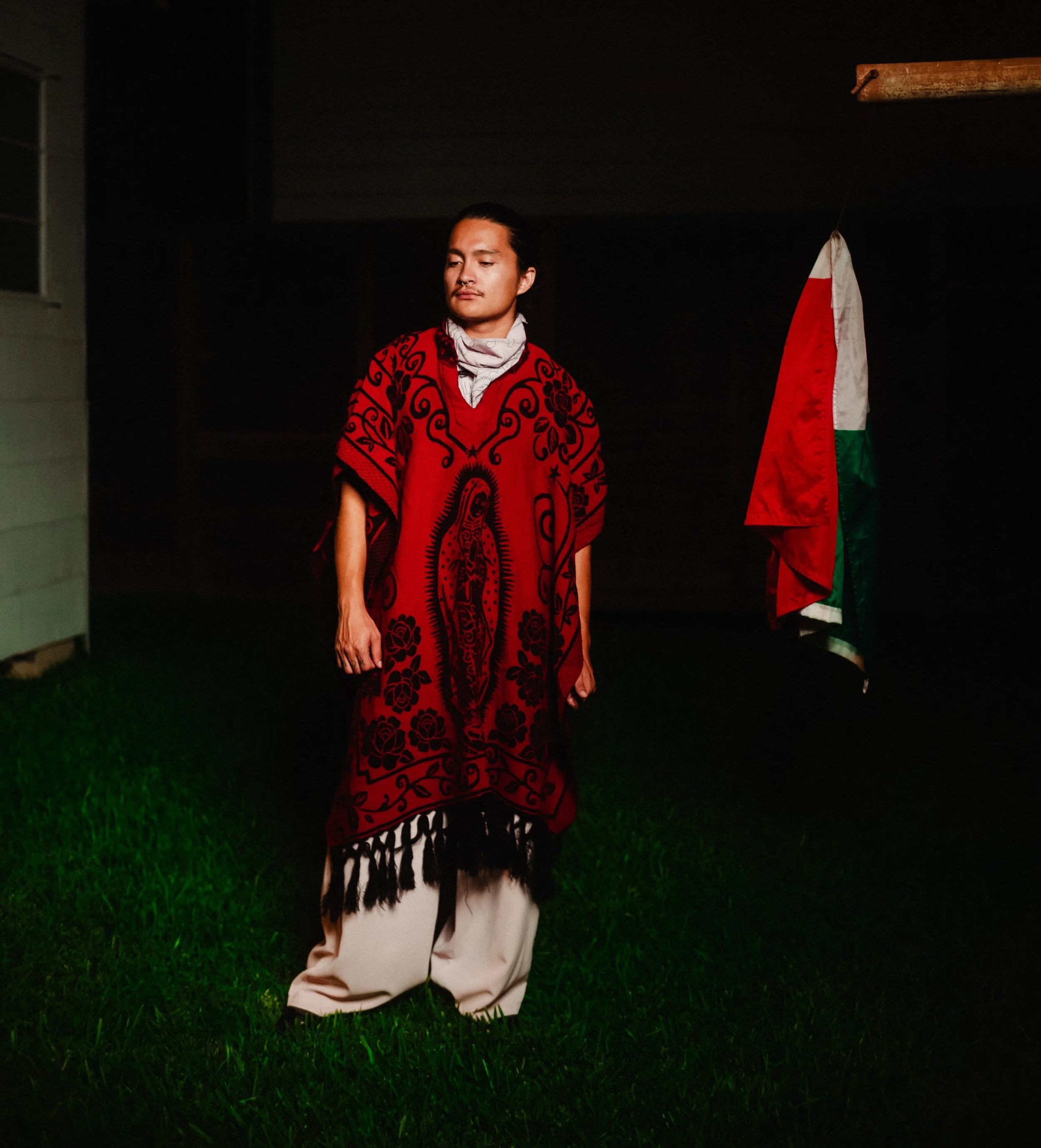
Sergio Valverde photographed by Gerardo Velasquez
We sat down to speak with Sergio Javier Valverde to discuss their upcoming short film, Los Plantas. The film tells the story of Angel, a Mexican-American refinery worker who gets into a fight with his wife and subsequently meets an older Mexican man who worked at the same refinery for years. We talked about the responsibility that comes with telling this story, what it means to shoot a short film in Houston, and the importance of collaboration in filmmaking.
EF: Seeing all the teasers of Los Plantas, I'm really interested in the genesis of the film, where was that initial spark?
SV: The genesis came from a class that I took, specifically, a screenwriting class during school. In my tenure at The Art Institute, those chain colleges that scammed people, I was one of them. But the teachers were great, the classes were great, and I'm grateful for the experience. But because that class was like, “come up with stories” I was like, “you know what? Let me try it.” The first draft that I did for the class was where it started. That version that I came up with two and a half years ago, wasn't anything I believed in. It started there, and it was born out of anger. I didn't make it out of love, I made it out of frustration, and I wasn't happy with it. You could tell from the quality of the script itself. It was just like, they go to a gas station and they’re refinery workers. There was also this subplot of an anarchist group who are targeting refineries around the states. Then the protagonist is part of one of those groups and there's that conflict. Anyway, at the end of it, it [the refinery] ends up blowing up. I always liked that visual, but that was the start of it. Later on, I had a renewed interest, because I like the title, and I like the setting, and I knew there was something there. After all of those years, life happened. I stopped working at the refineries. I'm older and I am trying to learn more about my Mexican background, my culture, and where I come from. We did my mom's DNA, and she's something like, 70% indigenous Mexican.
I was understanding where I came from a bit more, a bit better. Learning about our history as Mexican people, as indigenous people, and then where we are now as immigrants and laborers. A good chunk of laborers, especially in the blue collar field. Then I started to look at this script or this story from a different perspective. I wasn't looking at the refineries with this disdain anymore, I understood why it exists, I understood why people work there, why I worked there. Living here in Baytown, right behind me are refineries. I approached this different version with more understanding and compassion and empathy for the people who work there, people who decide to stay there. The people I met were really incredible.
Well there’s that idea of like, I'm working a job where I am physically taking something with my hands, something tangible, something real, and I'm creating things from it. But it's also completely stripped of any creativity in any way, right? I think it's awesome that you mentioned how this film is malleable, because all of them are, right? Films are malleable from every point of production, but it's interesting how you start from a place of anger and wanting to make something out of frustration, to working more from a place of empathy and love. I'm a big believer in films being empathy machines. How much do you think your collaborative efforts with other filmmakers and other people that want to tell this specific story has helped bolster the story to a point where it's going to get made?
SV: So it's pushed it beyond what I originally planned. I wanted to shoot this last December, very short, very quick, run and gun, because I wanted to shoot something. I wanted to shoot something because I hadn’t done it in so long, and I missed it. My original crew call that I posted back in December, was like, “Oh, I'm looking for X, Y and Z…I want to try to shoot this at this date.” That was the original plan. I was going to take care of production on my own. I was going to figure it out. Thankfully, somewhere along the way, our executive producer, Julissa (Guajardo), who's a very good friend and collaborator, came up to me after rejecting me once. I brought it up to them, and I told them about it. I was like, “oh, I want to do this, would you be down to help?” And they were like, “No.” Things worked out, and if it wasn't for Julissa coming on board and saying, “I want to push this, I want to do more with it” that really encouraged me to take another look at the script, get a couple more drafts in, figure out some other stuff, and really push myself creatively. That was Julissa, which really helped with that process of what this film is now, as it stands. A cultural story, and a very interesting perspective into being Mexican-American. Then Romina Palacios, our DP, was also really helpful because we spent a day just shot-listing everything that we had with a certain draft of the script. They brought up questions, and they weren't shy with questioning me about certain story decisions. Just giving me that different perspective, to change it. It's all these aspects, and I kept tweaking and tweaking until we had a meeting and decided that we gotta lock it in.
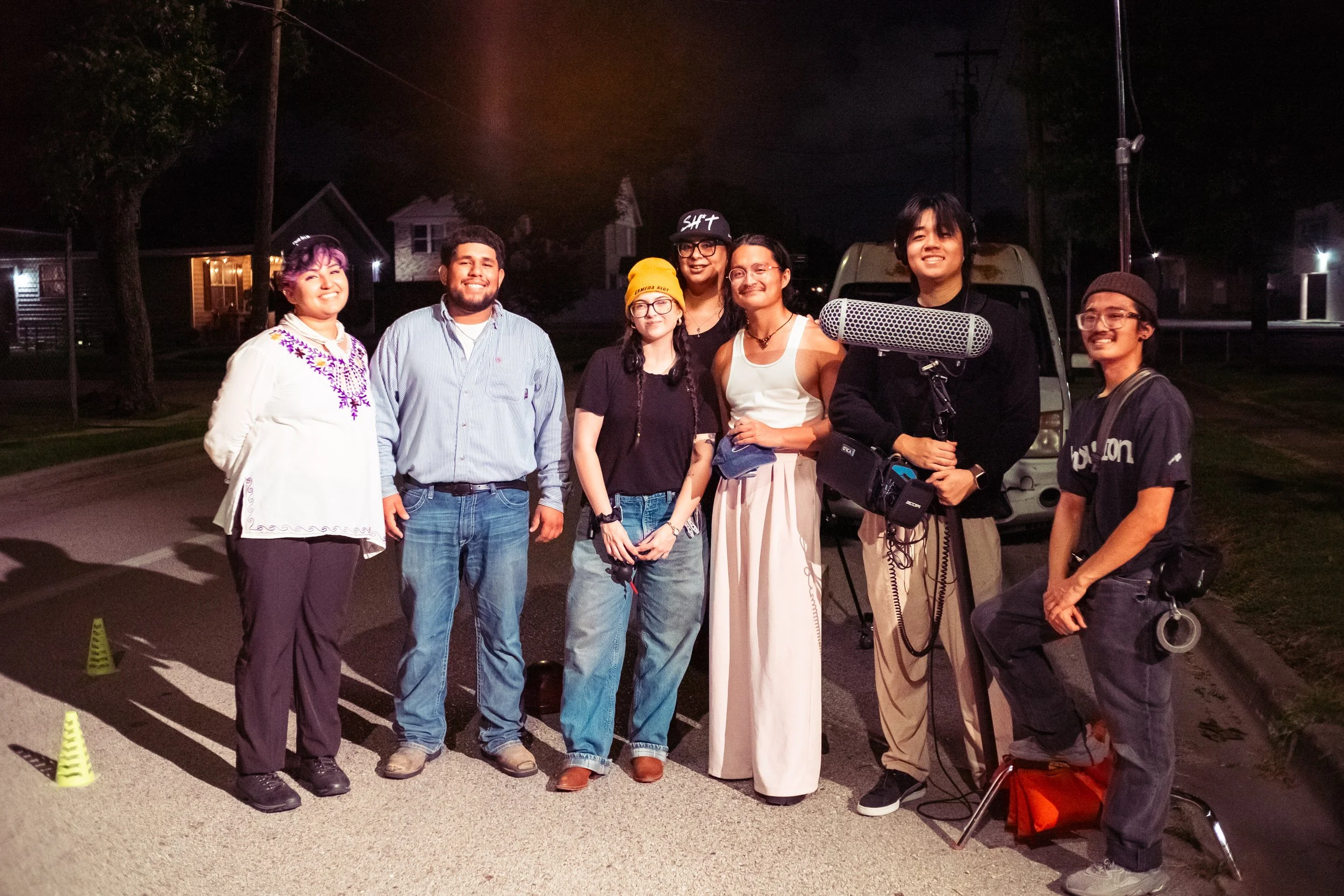
“Los Plantas” crew photographed by Rafael Elorza
That's what collaboration is for, it's surrounding yourself with people who have the ideas that you couldn't possibly have had. That's one of the awesome things about film, more than almost any other art form, you need other people. I mean, you can paint by yourself, you can make music in your room, but it's really hard to make a movie by yourself unless you're like Chantal Akerman. You mentioned how you know the film was developed for a couple years and goes through a couple drafts of the scripts, and then other people get in there, and it starts to change a little bit. One of my big things is North Star images, these images that you can see so clearly, so vividly in your head that you're working toward. All the other stuff might fall in line, but these North Star images are the ones that remain constant in your mind. What are a couple North Star images for you in this film?
SV: One big one is the title card. The title card has remained the same throughout it all. I want it [the title card] to be overlayed with a wide image of the refineries with Angel, and I wanted it to feel as if the refineries are surrounding him. Everywhere he looks, he just sees it, he hears it. For me, that's always been a consistent visual to associate Angel with that refinery. That landscape with the sounds, and whatever I can I can fit in the frame.
I love that you mentioned sound, because sound plays such a big part in your teaser that you posted. From the voicemail to the dreary, ethereal kind of atmosphere that you're setting. What do you want Los Plantas to sound like? What do you want those sounds to evoke?
SV: Sound is a big part of it. I could use what refineries usually use for their test sirens and all that, but I wanted to twist that a little bit. I mentioned that it's in the perspective of Angel, and how he perceives this thing. So, I wanted to use that sound, especially from the refineries, as an eldritch being, a mechanical siren that's drawing you close, but it's not good. There's this pull on him from the sirens and the refineries, where he feels like he has to go to it. The sounds he hears are kind of twisted. They're alive, but there's something, something not right with what he's hearing.
It’s this melding of sight and sound, right? It's really great to see a focus on that, and to understand how much sound plays a part in storytelling. So, this is a film about Mexican-Americans and what it means to be Mexican-American, what it means to be a Mexican-American man, what it means to work blue collar physical jobs in a state that sees you as probably less than human. But what does it mean to you to have this be a Houston movie, or at least a Houston-area set movie?
SV: I think it's the growing chicanismo within Houston that definitely plays into it. Houston is beautiful. It's diverse and filled with so many different things. I love it for the fact that I can go down the road find soul food, and then turn the corner find Asian food, and then Indian food, and I can find a fucking Mexican taco truck anywhere. It's all of these diverse things, but a lot of people who are in the area are blue collar. That's the job that is mostly widely available for everyone, that is consistent and reliable. So that's what essentially unites us, our class.
I think you're absolutely right, especially with all the construction and the physical labor. As a filmmaker, is it daunting or do you feel any fear about handling this story? Because it is a responsibility, right? It's a self-imposed responsibility, but do you have any fears about translating this very specific, very under-told story to screen?
“At the end of the day, every film that a Mexican makes is a Mexican film.”
SV: I think about that every day, and I did it to myself. I know that everyone is doing their own thing within the industry. It's been a beautiful experience just being able to witness other Latinos, other Mexicans, who either embrace chicanismo or just telling stories in general. At the end of the day, every film that a Mexican makes is a Mexican film. That's a belief of mine. The pressure is always there, but I love the pressure. I want the stress of it, because I want to ensure that I don't just fucking take steps without checking where I'm stepping. I've spoken to people about being blue collar, about being refinery workers. That's always important, because I've also lived the refinery life. I've woken up at 4am every single day, working six days a week. I’ve worked in construction, doing scaffolding, I know how that feels. I'm still blue collar, delivering packages every goddamn day, and even though that's different from being a refinery worker, it's still labor, it's still physical. I think that also helps me stay grounded, reminds me that I am the right one to do this because I live this every day. I'm not a nepo baby who got fed with the silver spoon and is now telling stories about class. And I'm not white either, so it helps to have that perspective. Being working class, coming from a family of working class people, everyone in my family, especially the men, work in refineries or work in construction. I talk to them every day, or almost every day, about it. Especially my cousin, who was our stand-in Edgar (Rodriguez), who lives this life. He goes to work at 4am, works six days a week to be able to pay all the bills that he needs to. He's got a kid, he's got a partner, and he was one of the first people that I shared one of the drafts with. Just to have him come back after reading it with no knowledge of filmmaking, he doesn't really know how a script is supposed to be structured, he doesn't know how the process usually goes. But he came back to me after reading the script, and he just embraced me. He affirmed my belief in the story and my capacity to tell it. He's been incredibly supportive every step of the way. Just having him, being Mexican American, being the refinery worker, this is his life and having his belief that keeps me going. Whenever there are days where I feel a lot of pressure, a lot of stress, that helps so much.
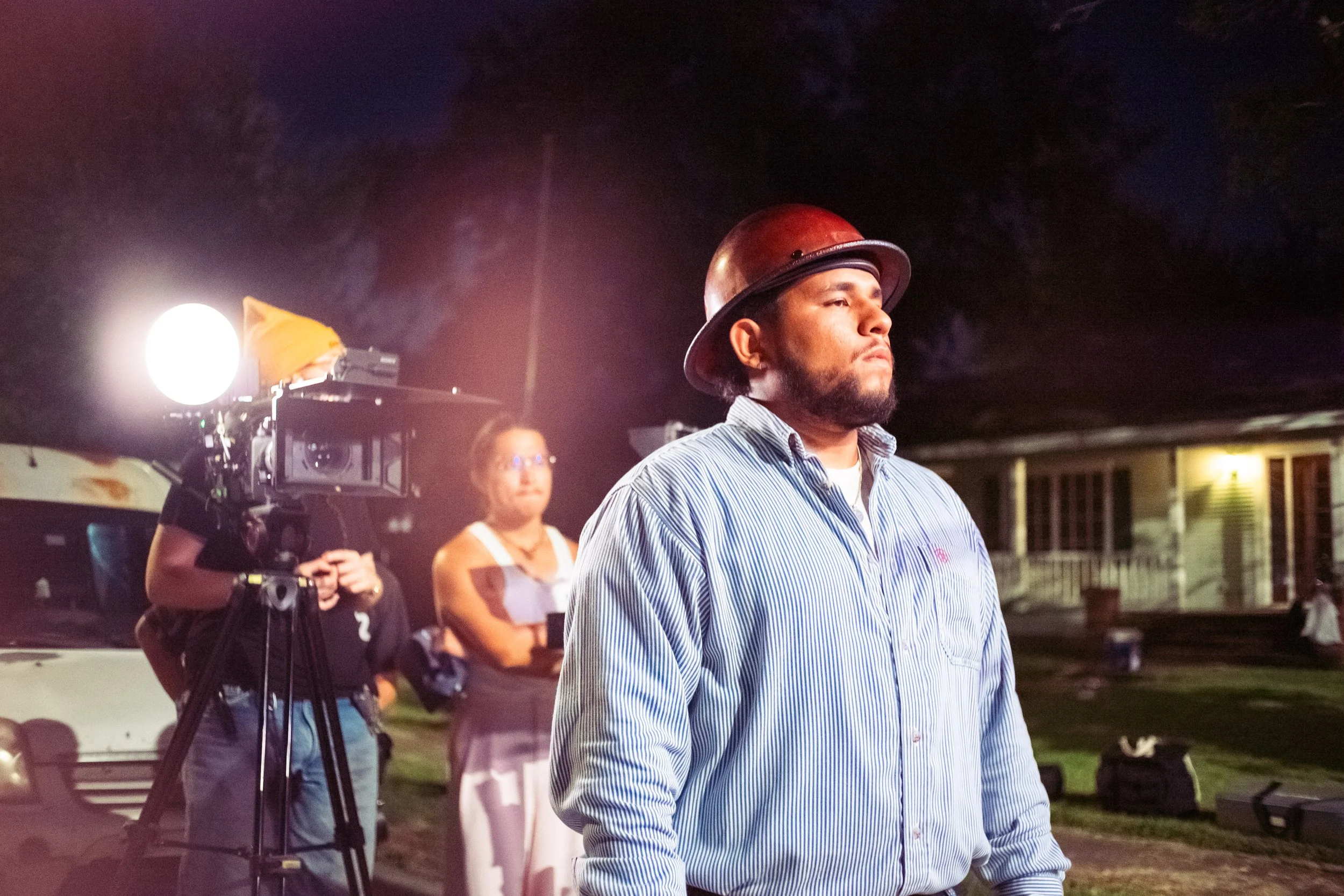
On set for “Los Plantas” photographed by Rafael Elorza
I hope you know, in my question, there was never any doubt in my mind that you're the right person to tell this story. I just can't imagine bearing that responsibility, the responsibility of a storyteller.
SV: And to add a quick point, I'm in the community as well. I'm not just writing and telling the story. I show up at protests, I show up in front of the fucking I.C.E. facilities, I show up at Brown Berets, or organized events, and community gatherings as much as I possibly can while working a blue collar job and while also working on this film. The people I've got to meet with, like Chicano Boulevard, for example, and the southeast that has Brown Berets, it's been incredible. Even just talking to them about the concept of the film and what it's about, they always have great feedback. It's always positive and affirmative, and being in community helps so much, especially when you want to tell the story that connects with those exact same people.
It's also really great, because everyone likes movies, right? Everyone likes movies to a certain point. It speaks to the power that movies hold, when you're able to make something with the hopes of reaching a demographic that doesn't even have the time to see movies. Like you said, it’s waking up at 4 am, working six days a week. Having the opportunity to go make something that can represent them and tell their story. I think that's a really powerful thing. So I guess that leads me right into my last question, which is: what are you most looking forward to capturing on set? Or rather, what is the thing that excites you the most at this point of getting into the production aspect of it?
Man, there's so many exciting things, we have two actors that are attached, who are incredible. We're not going to reveal until we have a full cast, but it's those two actors and they're perfect. They're beautiful and amazing. But for me it's getting to see them do the lines, to perform. We've done a couple chemistry readings, and just at that level, being able to see that and being like, “fuck me, this works.” It's always an exciting feeling just to get there and then working with Romina on the teaser as well was great. The communication was fantastic, and working with Romina has been incredible. I'm really excited to tackle a lot of the more complicated, really hard shit. There's a certain sequence that is a dance sequence to cumbia. That moment is probably the one I'm looking forward to the most.
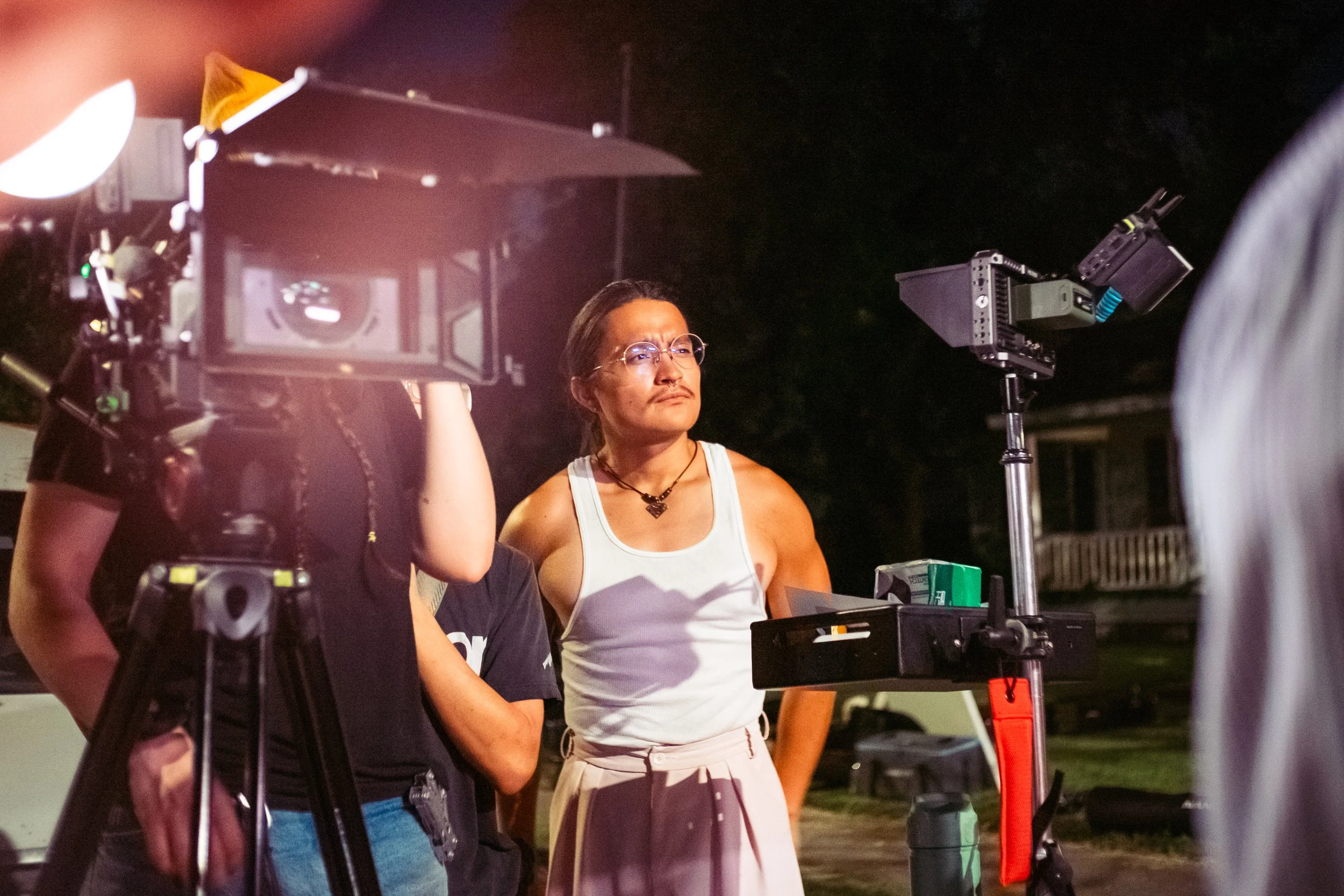
Sergio Javier Valverde on set photographed by Rafael Elorza
Cool man, that's awesome. Okay, plug away. Where, where can we support? Where can we follow? Where can we see the journey?
Probably Instagram, that’s the only place where we have a specific film page @losplantas_film. You can also follow me at @sjv.cineasta, or @pink_eye_pictures. But I always have to warn people to be careful, because you will receive pictures of pink eye (the disease) if you Google it. Which that's on me, I take responsibility.
Maybe we can change it, maybe you'll get so big that you'll be the top spot on Google, instead of pink eye.
That also might not be helpful, because people need to know what a pink eye looks like.
But then they're gonna have to go like, “Oh no, I didn't mean the film studio. I meant pink eye symptoms.
FOLLOW ALONG WITH SERGIO
On Instagram @pink_eye_pictures